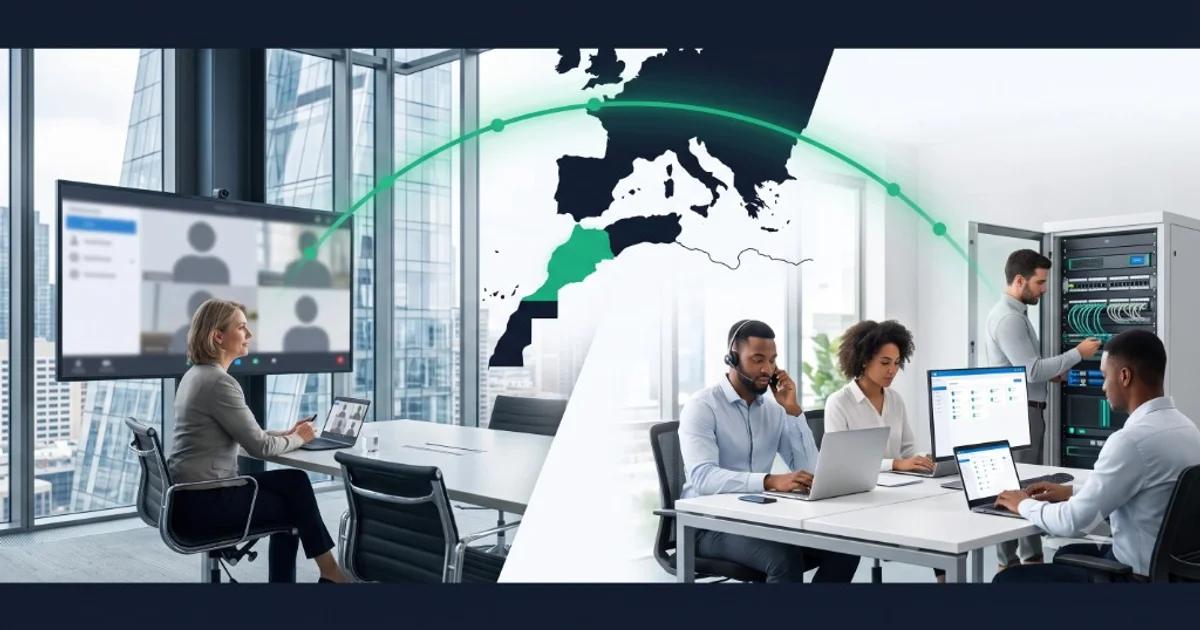
How foreign companies and MRE investors structure IT support for Morocco subsidiaries in 2026: remote TeamViewer/AnyDesk, on-site cabling, VPN, and managed IT from 1,500 MAD HT.
IT support subsidiary Morocco is no longer optional for foreign groups and MRE investors. When headquarters sits in Europe, the Gulf or North America, and teams work in Casablanca, Rabat, Tangier, Fès or beyond, you need a local partner who can fix Windows issues quickly, cable a new floor, and report back in language HQ understands.
AlloSupport.ma provides remote intervention via WhatsApp, TeamViewer and AnyDesk, plus on-site work when physics matters. Break/fix remote support follows a pay-after-result logic. Ongoing managed IT starts from 1,500 MAD HT/month for small fleets — the same transparent packs as our Moroccan SME offer.
Besoin d'aide maintenant ?
Intervention en 15 minutes. Satisfait ou remboursé.
À partir de
250 DH
🔒 Paiement sécurisé • Intervention enregistrée • Confidentialité garantie
This 2026 guide explains how to structure IT support for a foreign company subsidiary in Morocco without fake vanity metrics — only operational practices we actually deliver. For consumer-style PC issues, see also computer repair Morocco.
Key takeaways
- Prioritise remote-first support with documented on-site escalation for cabling and servers.
- Connect HQ and Morocco with a proper VPN — consumer Wi-Fi sharing is not a strategy.
- Managed IT from 1,500 MAD HT/month (≤5 seats) keeps costs predictable.
- Pay-after-result applies to many remote break/fix tickets; contracts cover recurring care.
- Choose a partner who works Morocco time zones and understands Law 09-08 basics.
- Use the French landing for filiales & MRE when you need implantation quotes.
Table of contents
- Why foreign subsidiaries need local IT support
- Remote vs on-site hybrid model
- Comparison table
- Managed IT from 1,500 MAD HT
- VPN, identity and Law 09-08
- Numbered onboarding protocol
- Do / Don’t
- Multi-city fleets
- FAQ
Why foreign subsidiaries need local IT support in Morocco
A subsidiary is not a home-office experiment. You hire staff, rent space in Maârif, Sidi Maârouf, CFC or Agdal, buy laptops, and suddenly HQ opens tickets about printers, ERP access, phishing mail and Wi-Fi dead zones. Flying a technician from Europe for every incident destroys budget and morale.
Local IT support subsidiary Morocco capacity solves three problems at once: language and time-zone overlap with Moroccan teams, physical presence for hardware, and knowledge of local ISPs, power incidents and building access rules. AlloSupport sits between your DSI abroad and users on the ground.
We do not invent client counts or “always-on” miracles. What we commit to is clear scoping, remote tools you can audit, and written next steps after each intervention — the same discipline we apply on computer-repair work for individuals and SMEs.
Foreign groups also underestimate Moroccan data-protection expectations. Law 09-08 and CNDP guidance affect how you store HR files, customer lists and session notes. A partner who documents interventions helps your compliance narrative without turning every ticket into a legal memo.
Another frequent gap is ownership: HQ assumes “the office manager will handle IT”, while the office manager assumes a European helpdesk exists. Naming a single WhatsApp escalation path removes that ambiguity on week one.
Remote vs on-site: the hybrid model that works
Most productivity tickets — slow PC, Office activation, VPN client errors, malware cleanup after a bad download — are faster remotely. With TeamViewer or AnyDesk, a technician can take control, gather evidence, and close the loop while your employee stays at their desk in Casablanca or Rabat.
On-site remains mandatory for structured cabling, rack work, access-point placement and some server migrations. The hybrid rule is simple: remote first for software; schedule on-site when copper, power or physical security is involved. That mix is how we support filiales described on infogérance filiales & MRE.
Break/fix remote jobs often follow pay-after-result: you validate that the issue is resolved before payment. Recurring managed service is different — you pay a monthly HT fee for capacity, reporting and priority queues. Mixing the two without explaining the difference confuses finance teams; we keep invoices labelled clearly.
If your HQ already runs an ITSM tool, we can work from WhatsApp alerts and send structured notes afterward. Perfect API integration is not always day-one; honest communication beats a fake “fully integrated” claim.
Remote sessions should be consented and time-boxed. We do not silently install permanent backdoors. When a ticket ends, access ends — that is part of trustworthy IT support for subsidiaries.
Comparison table: in-house, freelancer, managed partner
| Criterion | Full-time hire | Casual freelancer | AlloSupport managed |
|---|---|---|---|
| Cost predictability | Salary + charges + tools | Variable | Monthly HT packs from 1,500 MAD |
| Coverage | One person, leave risk | Depends on availability | Remote network + on-site capacity |
| HQ reporting | Depends on hire | Often informal | Ticket notes & optional monthly report |
| VPN / cabling | If skills match | Rarely end-to-end | In scope when contracted |
| Payment model | Payroll | Per hour / vague | Pay-after-result tickets + managed fee |
A full-time hire still makes sense above a certain headcount or when you need dedicated daily presence. Below that threshold, a managed partner usually wins on flexibility. Casual freelancers can help once — they rarely own monitoring, antivirus licensing and VPN documentation.
Managed IT packs from 1,500 MAD HT
Our SME-aligned packs apply to subsidiaries too. Pack Start at 1,500 MAD HT/month covers up to five seats with unlimited remote support within fair use, preventive maintenance and pro antivirus where included. Pack Growth at 2,800 MAD HT/month extends to 6–15 seats with richer reporting.
Details live on infogérance PME and the filiale landing. Prices are HT; VAT and on-site extras are quoted transparently. We refuse “unlimited everything forever” marketing — fair-use and SLA clauses protect both sides.
Managed IT is not a substitute for good backups. We help you design backup routines, but the subsidiary must own retention decisions with HQ. Ransomware readiness and MFA belong in the conversation before anyone celebrates green dashboards.
When a disk fails despite backups, escalate early to specialists — see our companion guide on data recovery Morocco.
VPN, identity and Law 09-08 basics
Inter-site VPN links HQ directories to Moroccan file shares or RD Gateway setups. Consumer mesh apps are not a long-term control plane. We configure site-to-site or client VPN with documented credential rotation and least-privilege access.
Identity should prefer MFA on Microsoft 365 or Google Workspace tenants used by the filiale. Shared passwords in chat groups are a recurring failure mode we explicitly discourage.
Law 09-08 awareness means minimising copies of personal data on unmanaged USB keys, knowing who accessed HR folders, and avoiding shadow IT. We are not your law firm — we operationalise sensible defaults so counsel is not discovering surprises after an incident.
Numbered onboarding protocol for a new subsidiary
- Discovery call (15–30 min) — HQ country, Morocco city, seat count, critical apps, existing tenant.
- Asset list — laptops, printers, firewall/router, whether cabling exists.
- Access kit — agree TeamViewer/AnyDesk policy and an admin WhatsApp channel.
- Quick wins — patch OS, enable MFA, remove obvious malware, stabilise Wi-Fi.
- Network plan — Wi-Fi/guest SSID and VPN design if HQ needs private access.
- Pack selection — Start 1,500 MAD HT, Growth 2,800 MAD HT, or custom.
- Pilot week — measure ticket types; adjust on-site days if cabling remains.
- Steady state — monthly preventive checks and optional written report for HQ.
Skip steps and you pay later in outages. Especially do not skip MFA and backup validation before migrating accounting files to a new NAS.
Do / Don’t for HQ IT managers
Do
- Do appoint one HQ owner and one Morocco office owner for tickets.
- Do budget managed IT as OPEX HT with clear seat bands.
- Do require MFA and documented VPN before sharing ERP access.
- Do keep a spare laptop image for replacements.
- Do use pay-after-result for one-off remote fixes when offered.
Don’t
- Don’t rely on one employee’s personal AnyDesk as your only support plan.
- Don’t ship unencrypted HR drives in checked luggage.
- Don’t assume European ISP habits apply to every Moroccan office building.
- Don’t demand “100% uptime” clauses without defining measurement windows.
- Don’t ignore phishing training — remote support cannot undo every clicked invoice.
Casablanca, Rabat, Tangier and multi-city fleets
Casablanca concentrates corporate offices; Rabat hosts administrations and NGOs; Tangier grows with industry and logistics. Multi-city fleets need the same remote standards everywhere and scheduled on-site days where hardware clusters.
If directors also need personal PC help, use computer repair Morocco. For storage failures, combine this playbook with récupération de données.
Start with context, not a vague “need IT”. City, seats, and whether you already have Microsoft 365 let us answer in one WhatsApp thread instead of five emails.
Procurement teams abroad often ask for a single RFP that covers laptops, licensing, cabling and 24/7 support. In Morocco, the pragmatic answer is a phased statement of work: stabilise identity and remote support first, then network design, then optional on-site days. Trying to buy everything in one opaque lump sum usually hides scope gaps that surface during the first month of operations.
Training matters as much as tooling. A thirty-minute WhatsApp walkthrough on phishing red flags for the Casablanca team prevents tickets that no SLA can fully erase. We include short enablement sessions when contracted — not as a vanity webinar, but as a checklist tied to your real apps (ERP, banking portals, shared drives).
Documentation should live where HQ can find it: a shared folder with network diagrams, Wi-Fi SSIDs (without passwords in clear text), VPN profiles and an asset spreadsheet. AlloSupport can maintain that pack; ownership of secrets remains with your administrators.
Power quality and UPS sizing are underrated in some Moroccan office buildings. A managed IT partner who has seen brownouts will ask about UPS before you blame random reboots on Windows updates alone. That operational humility is part of trustworthy local support.
Licensing authenticity also belongs in the conversation. Grey-market Office keys create support debt. We prefer tenants you can prove (Microsoft 365 / Google Workspace) and will say so rather than paper over activation loops every Monday morning.
Finally, measure what matters: ticket age, reopen rate, and whether the same printer incident repeats. Vanity dashboards with invented customer happiness indexes help no one. A short monthly note to HQ with three bullets beats a fifty-page PDF nobody reads.
On-site days should be booked with building access codes and a local contact who can open the rack. Remote brilliance cannot replace a locked server closet. Plan escort time the way you plan cabling copper — it is part of IT support subsidiary Morocco reality.
If you operate both a legal entity and a branch, clarify which entity signs the managed IT contract and who pays MAD invoices. Finance friction delays MFA rollouts more often than technology does.
Change management deserves a dedicated paragraph. When HQ pushes a new VPN client or MFA policy, Moroccan users need a go-live window that respects local working hours. Announce changes the day before, keep a rollback plan, and staff WhatsApp support during the first morning. That is how IT support subsidiary Morocco projects avoid self-inflicted outages.
Printer and scan-to-email workflows remain classic filiale pain points. Document drivers, SMTP relay settings and which PCs may print finance documents. Remote support can rebuild queues; on-site may still be required when USB chips or network ports fail physically.
Guest Wi-Fi should be isolated from finance VLANs. We repeatedly see visitors on the same SSID as ERP thin clients. Segmentation is not luxury — it is basic hygiene before you scale seats under a 1,500 MAD HT managed pack.
FAQ — IT support subsidiary Morocco
What does IT support for a foreign subsidiary in Morocco include?
Remote helpdesk via WhatsApp, TeamViewer or AnyDesk, on-site cabling when needed, VPN between HQ and Morocco, proactive maintenance, and optional managed IT from 1,500 MAD HT per month for small fleets.
Can we keep IT decisions at European HQ while operations run in Casablanca?
Yes. AlloSupport acts as local hands and eyes: you approve strategy remotely; we execute support, reporting and on-site work in Casablanca, Rabat, Tangier and other cities.
Is managed IT priced the same as for Moroccan SMEs?
Pack Start is 1,500 MAD HT/month (up to 5 seats) and Pack Growth 2,800 MAD HT/month (6–15 seats), aligned with our SME offer. Larger fleets get a custom quote.
Do you only work remotely?
Most user support is remote for speed. Physical deployment, server rooms and structured cabling are done on site in business districts when required.
How fast can you respond to a subsidiary ticket?
During business hours we aim for rapid remote take-over (often under 15 minutes for priority tickets). Exact SLAs are written into the contract.
How do we start?
Message us on WhatsApp with HQ country, city in Morocco, headcount and main needs. We reply with a short implantation checklist and a clear quote path.
Talk to AlloSupport on WhatsApp
Planning subsidiary or MRE office IT in Morocco? Send city, seat count and HQ country — we reply with a practical next step.
Conclusion
Sustainable IT support subsidiary Morocco blends remote speed, on-site craft, predictable managed packs from 1,500 MAD HT, and compliance-aware habits. AlloSupport.ma is built for that hybrid — without inflated promises.
Next: computer repair Morocco, managed IT packs, and HDD & SSD data recovery Morocco.